Medflow Systems
Unifying a Clinical Workflow System for Hospitals


Role:
Senior UX Designer
Team size:
8 people
Timeline:
11 months
Core tools:
Figma, Dovetail, FullStory, Jira
Overview
The problem
Clinical staff at three hospitals were navigating 11 separate tools for a single patient handover — spending up to 40% of each shift on documentation, with 200+ IT support tickets raised every month.
The solution
One adaptive dashboard with role-based views for nurses, doctors, and administrators. A 120-component design system built from scratch. Staff could complete a full handover in under 4 minutes.
Key outcomes
38%
Less time on documentation per shift at Medflow
62%
Fewer IT support tickets in the 3 months post-launch
4.6/5
Staff satisfaction score after rollout
38%
Less time on documentation per shift at Medflow
62%
Fewer IT support tickets in the 3 months post-launch
4.6/5
Staff satisfaction score after rollout
Research & discovery
Understanding the problem space
Contextual inquiry sessions were run across three hospital sites with 28 nurses, 14 doctors, and 6 ward administrators. We mapped every touchpoint in the patient handover process and identified 34 distinct friction points. Severity was ranked with clinical leads to prioritise which to solve first.


User interviews
Contextual inquiry sessions were run across three hospital sites with 28 nurses, 14 doctors, and 6 ward administrators. We mapped every touchpoint in the patient handover process and identified 34 distinct friction points. Severity was ranked with clinical leads to prioritise which to solve first.


Contextual inquiry sessions were run across three hospital sites with 28 nurses, 14 doctors, and 6 ward administrators. We mapped every touchpoint in the patient handover process and identified 34 distinct friction points. Severity was ranked with clinical leads to prioritise which to solve first.
Key findings
Shadowing front-line medical staff revealed 34 distinct friction points across the shift handover flow. Error rates spiked during manual data entry, and a vast majority of nurses felt the system actively slowed them down.
Multiple tools used
On average, staff switched between 9 different legacy systems to complete a single patient handover, drastically increasing cognitive load.
70% felt slowed down
7 in 10 nurses reported that the existing UI actively got in the way of patient care, particularly during high-pressure shift changes and emergencies.
High manual error risk
Because vitals had to be manually re-typed from physical monitors into the database, transcription errors accounted for the majority of data discrepancies.
Multiple tools used
On average, staff switched between 9 different legacy systems to complete a single patient handover, drastically increasing cognitive load.
70% felt slowed down
7 in 10 nurses reported that the existing UI actively got in the way of patient care, particularly during high-pressure shift changes and emergencies.
High manual error risk
Because vitals had to be manually re-typed from physical monitors into the database, transcription errors accounted for the majority of data discrepancies.
Design process
Creating lofi designs
We sketched 12 concepts across three directions — unified timeline, role-based dashboards, and a structured handover form. Role-based dashboards tested strongest in paper prototype sessions.


Design solutions
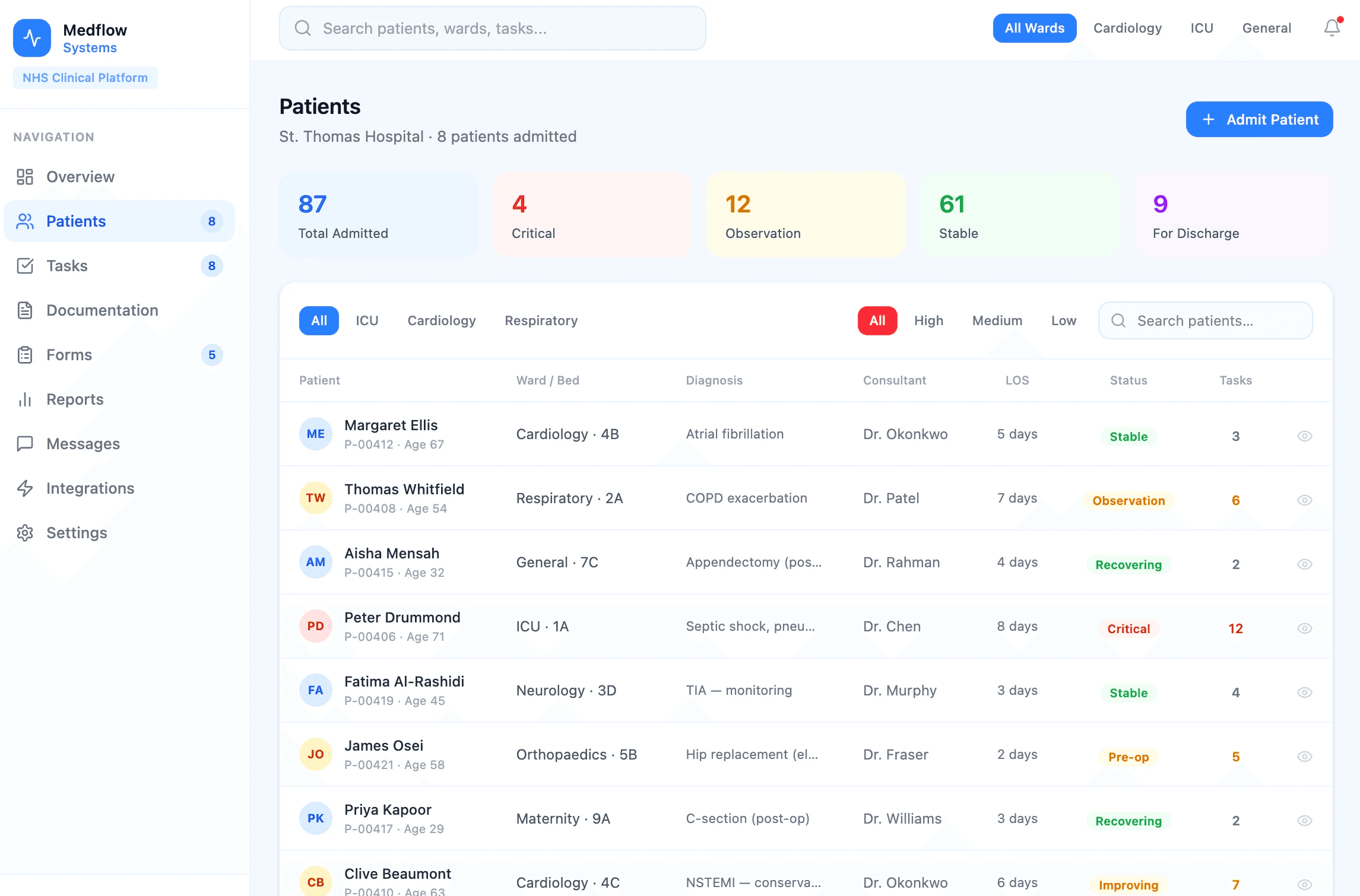


Impact
Key outcomes
£150K
Estimated annual saving in staff overtime from reduced admin burden
38%
Reduction in time nurses spent on documentation per shift
62%
Drop in IT support tickets in the 3 months after launch
38%
Less time on documentation per shift at Medflow
62%
Fewer IT support tickets in the 3 months post-launch
4.6/5
Staff satisfaction score after rollout